

Fermelanta Inc. is taking on what sounds like a science fiction challenge. “Producing valuable plant-derived compounds using microorganisms” – and turning it into reality through the cutting-edge field of synthetic biology.
Since its founding in 2021, the company has attracted significant attention for several reasons: its ability to select research themes that balance technical difficulty with market potential, its unique origin built on strong trust between researchers and entrepreneurs stemming from university research, and its large-scale funding secured in its Series A round.
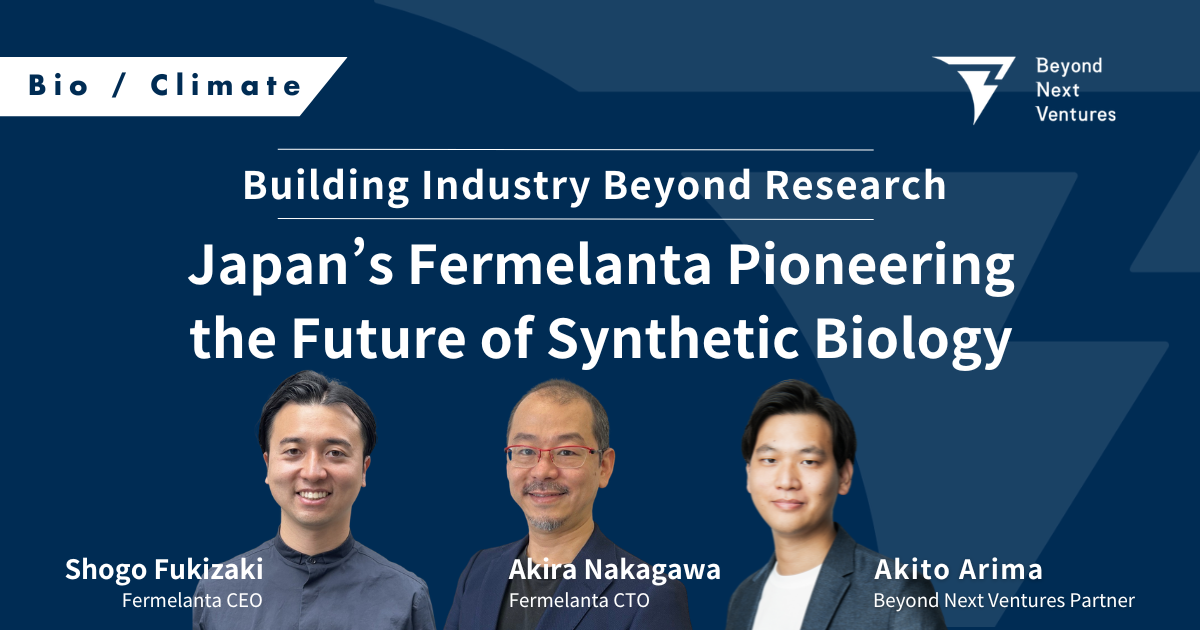
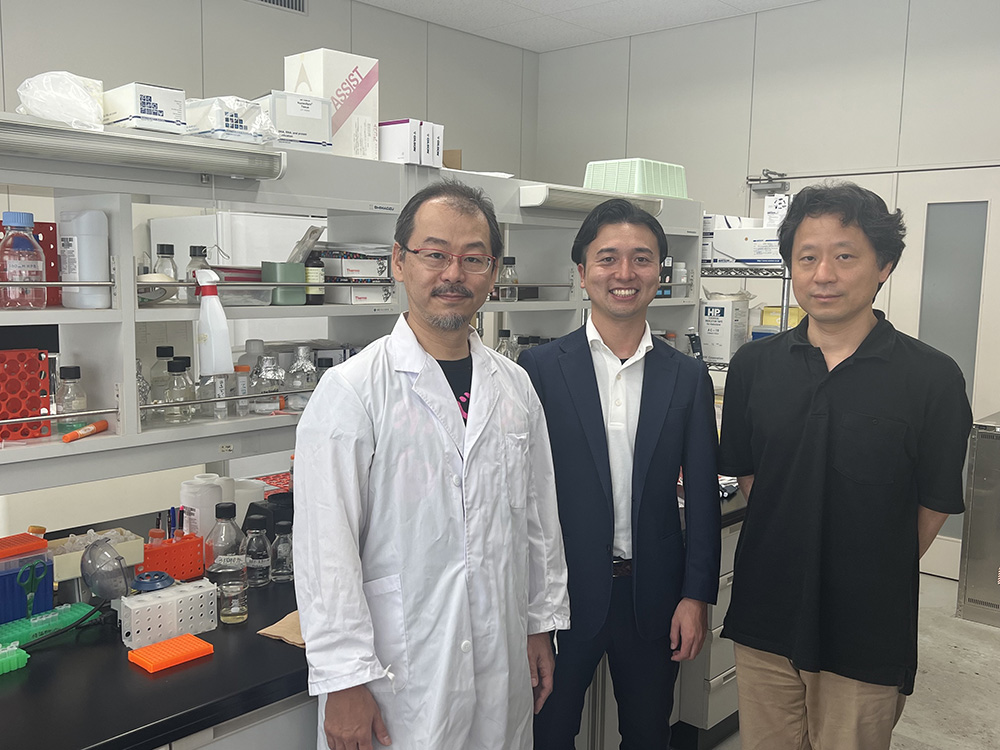
In this podcast session, we have with us CEO Shogo Fukizaki and CTO Akira Nakagawa from Fermelanta to discuss the background leading up to the company’s founding, its technological strengths, and its future outlook.
Speaker Profiles:
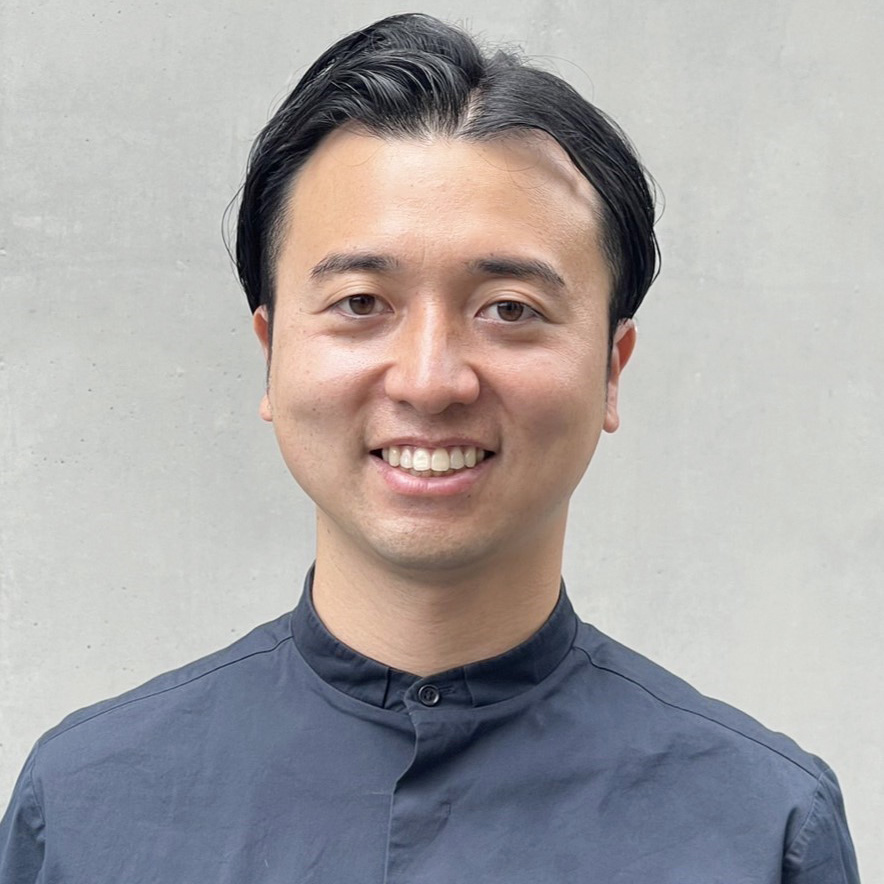
Fermelanta CEO
Shogo Fukizaki
Fukizaki started his career at Barclays Investment Bank and later joined Deutsche Bank, where he engaged in cross-border M&A and financing in the consumer and retail sector. Following that, believing in the technological potential of synthetic biology, he founded Farmeranta with his co-founders Minami and Nakagawa. He graduated from the faculty of economics of The University of Tokyo. He is a fellow of NEDO SSA (deeptech startup supporters academy in New Energy and Industrial Technology Development Organization).
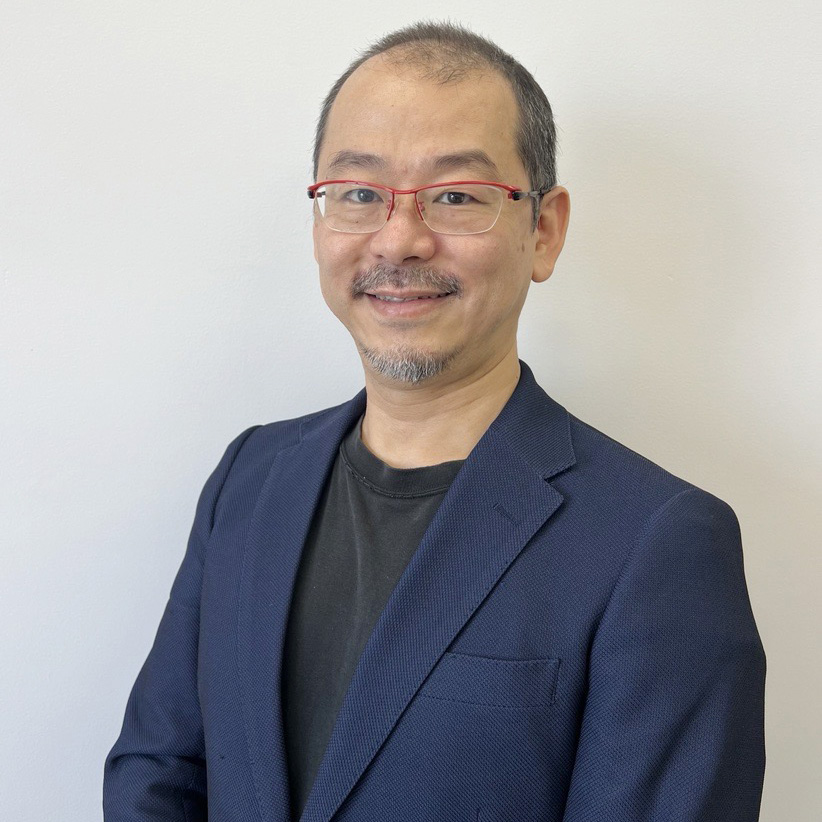
Fermelanta CTO
Akira Nakagawa
After serving as a postdoctoral researcher at Kyowa Hakko Kirin Co., Nakagawa joined the Institute of Biological Resource Engineering at Ishikawa Prefectural University. He served as Associate Professor at the same university until March 2025. He had a background in computer science and was fascinated by bioinformatics that control life, leading him to start research in the field of synthetic biology. As CTO of Fermelanta, he is developing fundamental technologies to engineer and control biosystem in microorganisms. He earned his Ph.D. (Bioscience) from Nara Institute of Science and Technology.
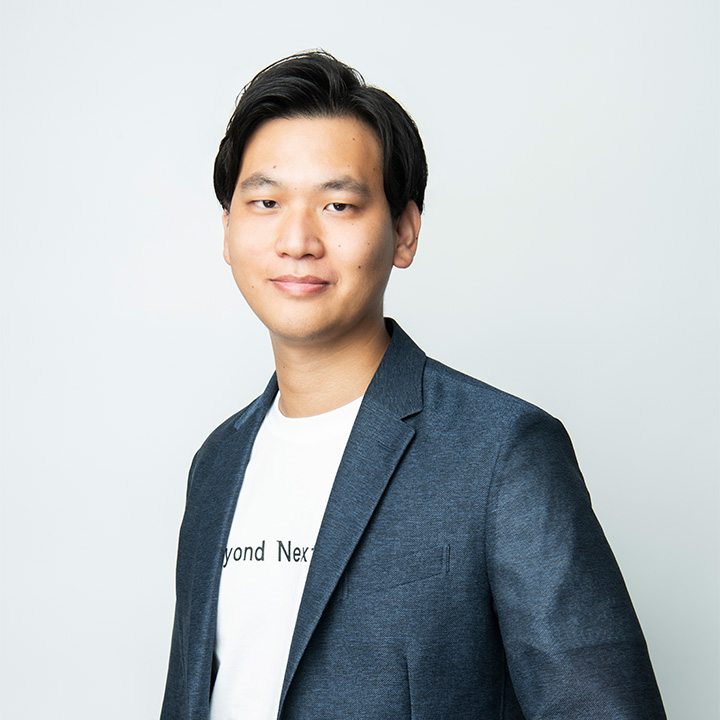
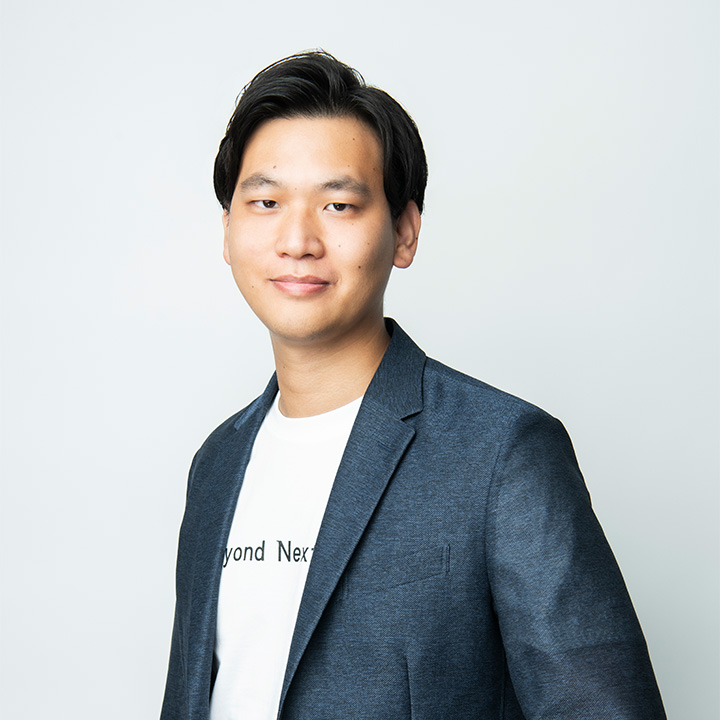
Beyond Next Ventures Partner
Akito Arima
Arima began his career at Marubeni Corp. in 2017, working across the agribusiness value chain and launching an investment team for agritech startups. Since 2019, he has been with Beyond Next Ventures, focusing on investments and hands-on support for agri-food tech startups. After his appointment as Partner in 2022, he also collaborated with the Ministry of Agriculture, Forestry and Fisheries and major corporations on industry–academia–government projects to drive innovation in food and agriculture. His goal is to help create the “GAFA of the agri-food sector.” He holds a degree in Biosciences and Informatics from Keio University.
The Founders’ Journey: What Led to the Company’s Creation
Arima: I’ve had the pleasure of working with both of you since before the company was founded and it’s been about four years now. Since we all have gathered today, I’d love to revisit the story behind the founding, the journey so far, and your research. Mr. Fukizaki, I would like to start with. Could you introduce yourself and tell us about the business?
Fukizaki: I began my career at an investment bank, where I spent about six years supporting M&A and fundraising activities for companies in Japan’s consumer retail sector. After that I founded Fermelanta.
Our business is based on the academic field of synthetic biology. It is a relatively new discipline that has developed since the early 2000s. Specifically, it involves engineering microorganisms by introducing genes to give them new functions, enabling the stable production of rare, naturally derived compounds. For example, if compounds that can only be extracted from plants could instead be produced by microorganisms, it would help resolve supply instability and also contribute to reducing environmental impact.
Arima: Thank you. I’d like to ask a bit more about your career. With your background in finance, what led you to step into this field?
Fukizaki: I had actually been thinking about starting a business since my student days, and at one point I came up with around 100 business ideas. However, none of them seemed likely to lead to something that could truly transform the world. I felt that if I started a company based on those ideas, it would be difficult to achieve something significant, so I decided to first gain work experience at an organization.
The reason I chose to work at an investment bank was influenced by my experience volunteering in Kenya. I had an interest in international cooperation and participated in volunteer activities, but I realized that grassroots efforts alone have limitations when it comes to changing the world and that capital is necessary. That experience led me to want to work in a field where I could move large amounts of capital, which is why I chose to pursue a career in finance.
Arima: After that you met researchers including Mr. Nakagawa, which eventually led to the founding of Fermelanta. Was there a defining moment or key factor that made you feel, “This is it”?
Fukizaki: A major factor was the alignment between my desire to create something that could significantly change the world and the technology that Fermelanta possesses. In my previous role, I was involved in the fermentation industry, which sparked my interest in manufacturing using microorganisms. However, when I actually started exploring entrepreneurship, I struggled to find a business idea that truly stood out.
In the process of consulting with various people, I met you (Arima) and participated in Beyond Next Ventures’ Innovation Leaders Program (ILP). Through the program, I also met our CSO and co-founder Hiromichi Minami and our CTO Nakagawa, which ultimately led to the founding of Fermelanta and brought us to where we are today.
Watching Minami and Nakagawa’s research up close, I realized that they were clearly working on something fundamentally different from others. I looked into examples overseas of the kind of research they were pursuing, but couldn’t find much, which made me realize just how complex and ambitious their work was. That’s when I became convinced that this was the kind of technology that could truly change the world.
From a business perspective, I also felt that it had strong potential for practical implementation and this was another key factor in my decision to start the company. I felt that if they were capable of creating highly complex compounds, then it should also be possible for them to produce simpler ones–indicating that the technology is highly versatile.
Arima: That’s true. Back then, the level of difficulty was exceptionally high, and you were aiming to produce compounds through quite unconventional methods. Since we’re on the topic of technology, Mr. Nakagawa, could you also introduce yourself?
Nakagawa: I was conducting research in applied microbiology at Ishikawa Prefectural University. At the time, however, I felt a sense of discomfort with doing research solely for the sake of publishing papers. I believed that there was no real meaning in my research unless I could carry it through to the point where I could say “it had actually been useful,” rather than assuming “it might be useful.”
Of course, I also had a desire to change the world, but more than that, I felt strongly about seeing my research through to its full realization. To do that, I believed practical application was essential, so Minami and I began working toward starting a company. Then we met Fukizaki through ILP and I felt that our opportunity to finally launch a venture had arrived, and we decided to start the company.
Arima: I still vividly remember how you described Mr. Fukizaki after your first meeting with him. You said he was “a nice guy and incredibly passionate.” Do you remember that?
Nakagawa: I still feel the same way!
Fukizaki and I come from completely different backgrounds, not only in terms of our careers, but we also have a 20-year age gap. Even so, I have a great deal of respect for him. There’s so much I can learn from him on the business side.
Biotech Research and Commercialization in Japan: A Global Comparison
Arima: I’ve really wanted to ask Mr. Nakagawa about the challenges in the research environment for synthetic biology. I believe there was a time when Japan was a global leader in this field, but recently the U.S., China, and Europe have been advancing rapidly with significant funding.
Given this context, could you share your perspective on the direction of research in Japan and how the market environment compares with overseas?
Nakagawa: This takes us back to what I mentioned earlier, but I feel that in today’s Japan there is still a strong tendency to focus on research aimed at writing papers. As a result, researchers tend to choose topics that are more likely to lead to publications, which in turn narrows the scope of research themes.
Of course, there are researchers who aim for real-world implementation and propose their technologies to companies, but in many cases, these efforts do not succeed. That’s because companies often have a conservative mindset and may reject such proposals outright. That said, now that I’ve actually started a company myself, I can understand that conservatism to some extent.
As a result of these factors, I believe that Japan’s willingness to take on bold challenges has weakened compared to overseas in recent years and there is a need to encourage a shift in researchers’ mindsets. At its core, research is inherently exciting and stimulating for researchers, so it would be beneficial to create systems that can tap into and amplify that sense of curiosity and motivation.
That said, there is no clear-cut solution yet. One approach we are taking is to demonstrate through our own work that world-class technologies do exist in Japan, and to serve as a source of inspiration for other researchers. With that in mind, we will continue to push forward with our research at Fermelanta.
Arima: I have a question from a technological standpoint. When looking at the global landscape, it seems that there hasn’t been much progress in research using E. coli (gut bacteria) to produce compounds with structures as complex as those Fermelanta is working on. Do you think this is an area where Japan could have a competitive advantage?
Nakagawa: In terms of technological capability, we believe that Japan, including Fermelanta, is by no means behind. There are many researchers in Japan with high-level technical expertise and we have strong competitive potential. However, I believe the reason this potential is not fully realized lies in the current system.
At present in Japan, even if a technology is highly advanced, the environment is not sufficiently developed to ensure it is properly evaluated and translated into practical applications. In other words, there is a lack of systems that enable talented researchers to bring their research to the world.
If we can build an environment and mechanisms that encourage more people to take on challenges, I believe Japan has the potential to lead the world in fields such as fermentation and synthetic biology.
For example, rather than the Western-style research approach that pushes forward with large volumes of data, there are areas where Japanese researchers can excel through meticulous optimization of conditions and persistent, incremental improvements. By leveraging these strengths and establishing an ecosystem that supports the full pathway through to real-world implementation, I am confident that Japan can compete at a global level.
Arima: I see. So the idea is to leverage Japan’s unique strengths, which differ from Western research styles, and translate them to real-world implementation. And for that we all, including VCs and operating companies, should shift toward building this ecosystem together as a society.
Fukizaki: I would like to add that there are several trends within synthetic biology approaches. In particular, I am focusing on the differences between the traditional research style of “applied microbiology” in Japan and the methodologies of “synthetic biology” that have evolved primarily in the United States.
In the field of applied microbiology, the mainstream approach has traditionally been to screen microorganisms found in nature, identify useful ones, and then improve them through selective breeding. In a sense, it’s a style of discovering and refining what nature provides, and it aligns closely with Japan’s long-standing fermentation traditions.
In contrast, synthetic biology as it has developed in the United States and elsewhere tends to feel more highly rational. It primarily relies on automation technologies and high-throughput experimentation to generate vast amounts of data, from which promising strategies are derived through statistical analysis in a highly rational manner.
Between these two approaches, I feel there is a missing piece: the kind of steady, foundational research required to truly understand and control biological systems.
For example, when asking questions like “Why does this microorganism produce this substance?”, experimental methods in synthetic biology alone often cannot provide the answer. Yet globally, research aimed at uncovering these fundamentals tends to be undervalued. There is a strong emphasis on efficiency and immediate results, but there is still so much we don’t understand when it comes to truly establishing a foundation for controlled biomanufacturing.
I also believe that this kind of careful, persistent basic research is particularly well suited to the strengths of Japanese researchers. By shining a light on this again and re-evaluating the intrinsic value of research, we may be able to fully unlock the potential of synthetic biology originating from Japan.
Arima: Since the discussion has turned to global perspectives, I’d like to ask Mr. Fukizaki that you’ve traveled extensively, engaging with companies and tracking technological trends around the world. How do you think Japan and Fermelanta are perceived internationally?
Fukizaki: I do get the sense that we’re recognized as “a company doing something quite remarkable.” Our technology is seen as having a competitive edge, and I am also gaining a positive sense of how this can be translated into a business.
That said, it’s not without challenges. Some overseas companies, for example, limit their R&D scope by saying, “We only work with yeast.” When we explain that we use E. coli (bacteria found in the intestine), there are cases where we’re dismissed outright. So even when there is strong technical interest, there can still be barriers to acceptance.
Arima: This ties back to the differences in research approaches overseas that Mr. Nakagawa mentioned earlier. Foreign companies perhaps adopt an approach where they consider various possibilities and then select the most suitable option?
As globalization advances in this field and technologies become accessible regardless of national boundaries, it may be turning into a smaller, more interconnected world. At the same time, it feels that the distinct edge of individual companies is becoming more pronounced.
Building on the Series A Foundation & Addressing New Challenges: Our Latest Fundraising
Arima: I’d also like to ask about your Series A fundraising, which exceeded 2 billion yen. In just three years since founding, you’ve secured a cumulative total of around 4.8 billion yen in funding. Please tell us about your journey so far and your thoughts on this latest fundraising.
Fukizaki: First of all, being able to secure multiple large-scale grants over the past three years has really helped us move our business forward. Receiving financial support at a stage when we were beginning to see a path toward practical application of our technology was extremely valuable.
We have a proven track record of successfully producing highly complex compounds and that has been recognized as one of our key strengths. Once producing these high-value compounds becomes feasible, it significantly enhances the business case. And as mass production and stable supply become achievable, it also makes the scalability of the business much clearer.
Another perspective we place great importance on is building an industry. We are not just aiming to establish a business—we want to contribute to the creation of an entirely new industry. To achieve that, we ourselves need to grow significantly. That’s why, from the very beginning, we have maintained a strong commitment to manufacturing.
Arima: Amid the current surge of interest in synthetic biology, I think Fermelanta has clearly articulated its value and vision while steadily advancing its global expansion. It’s also possible that effectively communicating the strengths of the research team, led by Mr. Nakagawa, resonated strongly with investors and reviewers.
As CTO, did you have any particular thoughts during the fundraising rounds?
Nakagawa: I felt that “we can leave fundraising to Fukizaki and be confident it’s in good hands,” so I entrusted it to him! That said, when it comes to fundraising, the scale of capital involved is on a completely different level compared to academic research, and I’ve been feeling a kind of pressure I had never experienced before.
It’s different from when I was dealing with 10 or 20 million yen. Now we’re talking about hundreds of millions. If we make the wrong decisions there’s a risk of jeopardizing entire projects, so I’m very aware of the weight of that responsibility.
Arima: I see. Compared to your time in academia, do you feel that the larger scale of funding has expanded what you’re able to take on?
Nakagawa: Yes, I feel that change very strongly. Also, having spent a long time in academia, I realized that my thinking had a tendency to stay small and contained. Even though I needed to make proper use of the funding we received, at the time of founding I was unconsciously trying to limit the scope of my ideas.
But now, I’ve become more accustomed to thinking in terms of “we can achieve something much bigger,” and I feel my mindset has evolved compared to what it was before.
Arima: I agree. That’s a significant difference. As a way to broaden researchers’ perspectives, it may be worthwhile to consider startups as an option.
A Major Push Toward Industrialization and Deepening Collaboration
Arima: Following your Series A fundraising, could you share the future that Fermelanta is aiming for, as well as the kinds of companies you hope to collaborate with going forward?
Fukizaki: During the seed stage, we focused on expanding our R&D capabilities and establishing our technological foundation. Thanks to that, we now have a research structure we’re fully satisfied with and our collaborations with multiple companies are progressing steadily.
Building on that foundation, we are now moving fully into the manufacturing phase in this Series A round. We’ll begin by scaling up sample production to demonstrate its value as a product–in other words, achieving productization is our near-term goal.
Once that is proven, the next step will be entering the mass production phase. Since we operate in the raw materials business, we believe that achieving scale and reducing costs will enable us to establish a more robust and sustainable business model.
At this stage, the funds we’ve just raised carry significant importance. We have already mitigated technical risks to a certain extent, and the focus going forward will be on validation and scaling up. If we can overcome these hurdles, we will have a clear path toward the next stage, including the construction of commercial-scale plants.
What we are aiming for is not merely to succeed as an operating company, but to create entirely new industries. Rather than aiming for companies on the scale of tens or even hundreds of billions, we are aiming for a completely different level of scale. To achieve this, we believe that expanding our manufacturing capabilities and strengthening partnerships with external companies will become increasingly important going forward.
Looking ahead, we are considering three primary co-creation models: creating new projects, integration of our proprietary development pipeline, and collaboration in manufacturing.
Creating new projects refers to jointly producing new materials based on a company’s needs or challenges within its supply chain. For example, this could involve using our technology to realize high-value-added materials that cannot be sourced through their existing suppliers.
Integration of our proprietary development pipeline means partnering with companies that adopt our product lines or collaborate with us on market deployment strategies.
Since commercial-scale plant construction requires significant capital, in the manufacturing collaboration model, we leverage partners’ existing manufacturing infrastructure to achieve meaningful efficiencies in both time and cost.
Additionally, we are exploring innovation in fermentation processes themselves. The industry has long relied on established conditions and methods, and there is a clear need for new approaches.
The adoption of new fermentation technologies–such as continuous cultivation and non-liquid fermentation–along with the analysis and optimization of media compounds, remains largely untapped. We believe that by bringing in new entrants from other fields, it is possible to drive innovations that could not have emerged within the traditional fermentation industry.
Arima: By bringing in new perspectives, we can complement each other’s viewpoints, opening the door to innovation. I’m really looking forward to seeing your progress in commercialization and global expansion.
Before we finish, Nakagawa-san, could you share your aspirations going forward?
Nakagawa: Personally, I should convey my determination to devote myself wholeheartedly to research. Fortunately, we now have an exceptionally talented team and an environment where we can push forward with R&D in a strong and focused way.
That said, there are still areas where we haven’t been able to generate as much data as we expected, so there is still considerable room for improvement. To truly take our research to the next level, I believe it’s not just about individual effort –we need a system where the entire team works in sync.
I am confident that once all the right pieces start working together, we will achieve a major breakthrough. It’s been three years since we started this venture and now we are at a critical turning point. But I can already see a future where, once this system is fully in place, everything will flourish at once. I would greatly appreciate your continued support.
Arima: Thank you. Research progresses step by step, built on continuous daily efforts. At Beyond Next Ventures, we have full confidence in Nakagawa-san’s team and will support you wholeheartedly.
Looking at the current state of academia in Japan, it is not uncommon for research to lose funding and stall once a project concludes. It’s a real loss to see the knowledge and assets accumulated over time simply disappear.
By demonstrating how a university spinout like Fermelanta can translate research outcomes into real-world implementation, we believe it can help shape the future of science and researchers across Japan. We share that vision and will continue to support you with our full commitment.