

Brain–machine interfaces (BMIs), which integrate neuroscience and AI, are gaining increasing attention due to their potential to transform healthcare delivery. However, translating research findings into real-world applications remains a major challenge.
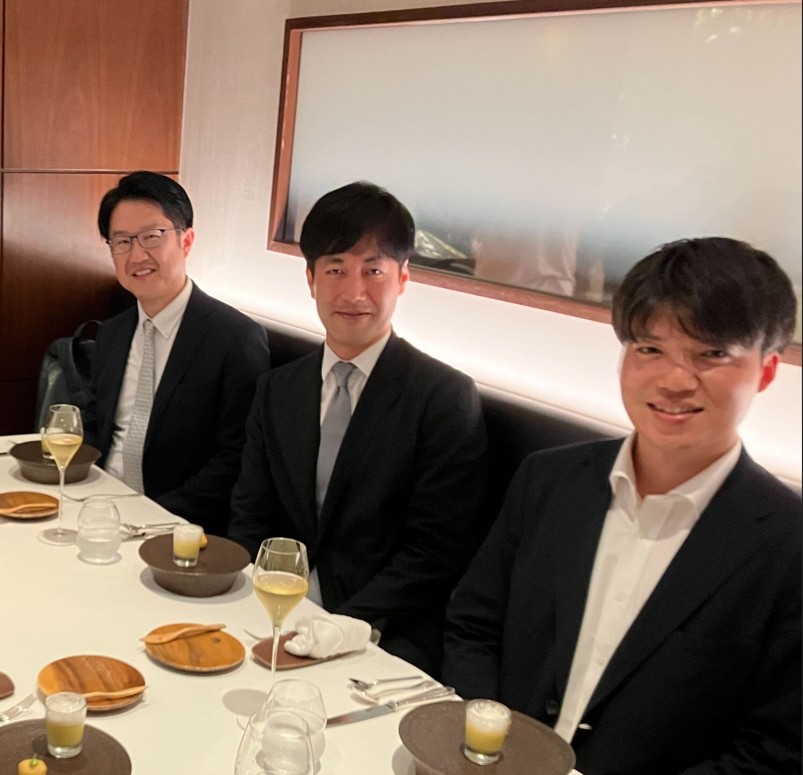
We spoke with LIFESCAPES Inc. President Junichi Ushiba and Vice President Masaaki Hayashi to learn more as they are developing BMI-based rehabilitation solutions for patients with severe paralysis. The duo talked about the firm’s founding, the key features of their technology, and their efforts toward real-world deployment.
Profile
Junichi Ushiba
President, LIFESCAPES Inc.
Faculty of Science and Technology Dept. Biosciences & Informatics Professor, Keio University
Ushiba earned his doctoral degree at a record young age and was also the youngest to obtain a tenured position. He became head of a neuroscience laboratory when he was 35 years old, and was the first in the Faculty of Science and Engineering to receive approval to concurrently serve as a company representative director. His areas of expertise include neuroscience, rehabilitation medicine and data science.
Ushiba has authored over 100 peer-reviewed original papers in English and has received numerous awards, including the MEXT Young Scientists’ Prize, and the Nakatani Award for Advancement of Measuring Technologies in Biomedical Engineering.
Masaaki Hayashi
Vice President, LIFESCAPES Inc.
After completing a master’s program at the Keio University Graduate School, Hayashi joined DeNA Co. He led new business development in the healthcare domain there, along with service planning for pharmaceutical companies, corporate sales, and alliance management. While working at DeNA, he engaged in both basic and clinical research on BMI at the Keio University’s Graduate School and later earned a Ph.D. in Science.
In 2021, Hayashi joined LIFESCAPES to help bring research into real-world applications. He is also a researcher at the Faculty of Science and Technology, Keio University.

Katsuya Hashizume
Executive Officer / Partner / Investment Manager, Beyond Next Ventures Inc.
Hashizume joined JAFCO Group Co. in 2010, where he served as Leader of the Industry–Academia Collaboration Investment Group and consistently focused on investments in university-originated startups for about 10 years. He joined Beyond Next Ventures in 2020 and has been involved in investments in startups in the medical device and digital health sectors. He was appointed Executive Officer in August 2021.
While leading the investment division, he oversees the management of the portfolio companies’ community. His notable investments include Microwave Chemical (IPO), Biomedical Solutions (M&A), and Bolt Medical (M&A). His hobby is surfing, and he lives in the Shonan area. He completed his studies at the Graduate School of Media and Governance at Keio University.
AI, Neuroscience And Healthcare – The Moment Individual Interests Converged Into a Single Research Theme
Hashizume: Mr. Ushiba, could you tell us about your journey so far? What led you to your current research theme and what first sparked your interest in this field?
Ushiba: It’s a bit of a long story, but for me there is a very clear starting point. When I was in elementary school, there was an AI boom somewhat similar to what we see today. However, at that time, it was still quite rare for households to have personal computers and schools hardly had any either. During that period, my elementary school introduced computers and allowed us to use them after the classes got over.
That’s when I had the opportunity to interact with something like what we would now call ChatGPT. I realized that it was possible to create something like human intelligence through programming and I was deeply fascinated by it. From there, I became what you might call a computer enthusiast.
Later, when I entered junior high school I became interested in neuroscience, thanks to a lecture by a neuroscientist. I remember the scientist told us that if patients –with even nearly half of their brain surgically removed–continue rehabilitation, then the remaining parts of the brain can take over those functions, allowing them to recover almost perfectly.
That was extremely striking to me. It made me feel that the human brain, much like AI, can rewire itself through accumulated experience. I think that was my formative experience of encountering both the mystery of the brain and the hope it holds.
Hashizume: AI and neuroscience may seem like separate interests, but looking back, they clearly connected to what you’re working on now.
Ushiba: That’s right. But at the time, I never imagined those interests would connect. At each stage, I simply found myself thinking, “AI is fascinating” or “neuroscience is intriguing.” I think people around me probably saw me as someone dabbling in a bit of everything, and even I couldn’t clearly explain what I was truly interested in.
Hashizume: And then, later on, the element of healthcare also comes into the picture.
Ushiba: Yes. When I was in high school my grandfather suffered a stroke. He got paralysis on one side, lost the ability to speak, and had to live in a wheelchair. Of course, it was incredibly difficult for him, but for me personally, experiencing the challenges of caregiving was also a very significant event.
By the time I joined a research lab at the university, I had a clear desire to help people suffering from the same conditions as my grandfather. However, I still didn’t have a clear idea of exactly what I would do.
The AI that fascinated me in elementary school, the mystery of the brain I encountered in junior high and the experience of caregiving in high school kept circling within me. They weren’t connected as a single, clear line from the beginning; rather, over a long period of time, they gradually came together within me.
At one point, I had the idea that it might be possible to analyze brain signals using AI and then use robotics to feed that information back into the brain – essentially enabling the brain to heal itself. Looking back, it may sound a little too good to be true, but I believe that by simply pursuing what I found interesting at each stage, I eventually arrived at my current research theme.
Hashizume: So the problem you wanted to solve had always been there, but the way to approach it only became clear when those seemingly unrelated interests within you came together.
Ushiba: That’s exactly right. If one relies too heavily on backcasting from the problem then one tends to end up with solutions that are merely extensions of what already exists.
On the other hand, even if things seem unrelated at first, if you continue to hold onto what persistently captures your interest then there comes a moment when you suddenly see a kind of connection point that only you can recognize. For me, that was BMI.
Why a Researcher Decided To Pursue Entrepreneurship
Hashizume: Next, I would love to hear about how you got to the point of starting your company. There must have been various options for bringing your research into society–such as licensing out or joint research. But why did you choose to start a company instead?
Ushiba: Honestly, I had never imagined myself going into business and didn’t even go through the usual job-hunting process. I had a strong inclination toward academia, so I went straight into a doctoral program and continued along that path.
I worked on using AI to analyze brain signals in real time and employing robotics to assist the movement of paralyzed limbs, thereby altering the state of the brain itself. I found great joy in building such neurofeedback systems and in demonstrating that brain function could indeed be changed.
What prompted me to pursue real-world implementation was the opportunity to have stroke patients use the technology I had been researching. One patient said to me “I may not directly benefit from this (your research), but please keep working for people like me.” Those words really stayed with me.
Hashizume: That sounds like a major turning point.
Ushiba: Yes, it really was. While I could write about such incidents in academic papers, I began to feel that alone wasn’t truly solving the problems faced by patients in front of me or the challenges within healthcare. At the same time, I felt a clear responsibility to ensure this technology reaches society.
However, at that stage, I still didn’t intend to start a company myself. I believed it would be best if I could bring the technology into society while remaining in academia and in fact I was working with a company to develop a prototype. We had made considerable progress, but due in part to the Lehman shock, the company ultimately withdrew from the medical device business.
I simply couldn’t accept seeing everything we had built up to that point disappear. I resolved that I had to take the risk and continue the work myself. So rather than starting a company out of a proactive desire to become an entrepreneur, I ended up choosing that path as a way to see it through to the end.
Hashizume: There must have been a significant gap between aiming for social implementation as a researcher and actually starting a company, right?
Ushiba: Yes, a very large one. In academia, you can take your time and focus deeply on research, but in a startup, you have to produce results within limited timeframes and keep moving forward while having that value recognized. Although I understood this in theory, adapting to that speed in practice was extremely challenging.
At that time, I encountered Beyond Next Ventures, and they encouraged me to apply to an acceleration program called BRAVE that was starting in three days. I hurriedly prepared and joined the program. There, I worked with experts in regulatory affairs, finance and medical device businesses, and for the first time gained experience in building out a business plan and financial strategy.
Following that, I had another opportunity to present our business plan to Beyond Next Ventures. I still vividly remember being told quite bluntly that “you’re not fully committed yet.” Through this experience, I learned not only how to build a business, but also the mindset and determination required to navigate the startup journey.
Building a Management Structure To Bring Research Into Society
Hashizume: I would like to hear from you as well Mr. Hayashi. You’ve had quite a unique set of experiences. As a student, you conducted research in Mr. Ushiba’s lab, and after working somewhere else for a while, you joined LIFESCAPES. Could you tell us how you first encountered this research theme and how that led you to where you are today?
Hayashi: The initial trigger was when I heard about Professor Ushiba’s research while I was in high school. I intuitively felt, “This is really fascinating.”
At the time, I was not particularly strong in science subjects, but my desire to pursue this research led me to enroll in a faculty of science and engineering. As an undergraduate, I joined a lab and continued researching BMI throughout both my undergraduate and master’s studies. During this period, I also had opportunities to participate in clinical research as a student, including working with patients who used a BMI system that I had programmed myself.
At that time, a patient told me something along the lines of, “I hope this will not only help me now, but also benefit patients in the future.” Hearing that, I felt strongly that this technology shouldn’t remain confined to research, but should be brought into society.
Hashizume: Did you consider the business perspective alongside your research from an early stage?
Hayashi: I had always wanted to build my capabilities in the business domain and at the same time I strongly felt the power of research and its impact on society. That’s why I spent my student years aiming to understand both research and business, and to become someone capable of driving both forward.
Hashizume: I see, that’s why you decided to get a job after graduating.
Hayashi: Around the time I started my job, LIFESCAPES had just been founded. I remember telling Professor Ushiba, “I’m sorry, but I won’t be joining LIFESCAPES just yet.”
I decided to first learn the fundamentals of building a business, and then join LIFESCAPES afterward. After some time, Professor Ushiba reached out to me, and I joined the company. Personally, I had always wanted to bring BMI technology to practical use someday, so it felt like a natural progression.
Hashizume: With Mr. Hayashi’s recent appointment as vice president, it appears that your organization’s management structure has been further strengthened. Mr. Ushiba, how do you see this development?
Ushiba: When we founded the company rehabilitation medicine using BMI was not yet seen as a sufficiently realistic field, neither in Japan nor internationally. Therefore, initially, a major challenge was getting society to understand whether BMI truly had value as a medical technology and whether it could stand as a viable market.
I believe that the trust and relationships I built over 20 years in this field – by doing research, writing papers and engaging in various academic activities – became a major force supporting the company. In a way, I felt it was my responsibility and something only I could do, to lead the effort to create a situation where people would think “If Ushiba is doing it, let’s give it a try.”
Once the product was introduced in hospitals and its therapeutic effects for patients started to become visible, the company entered its next phase. Today, our product is being used in more than 60 hospitals nationwide, and it feels that our vision is turning into reality.
However, we are now entering a phase where we need to scale this value into a full-fledged business. As I remain engaged in developing new technologies and pursuing scientific research at the university, the time I can commit to this product is naturally limited. Therefore I feel that at this stage the company shouldn’t be led by me as a researcher, but by professionals who can drive business growth.
So it feels only natural that someone like Hayashi takes on a central role at this stage.
Hashizume: So timing-wise as well, Mr. Hayashi was the right person for the role.
Ushiba: Rather than joining the company right from the start, Hayashi made a conscious decision to first gain experience externally and then bring that business related knowledge into LIFESCAPES. In reality, there have been situations where he has taken risks and led the way through difficult phases, and has even been blunt to me. Because of that I have a great deal of trust in him.
From a research perspective as well, he’s someone who has the ability to follow through on his decisions. I see him as a core leader who can drive the company forward in this current phase.
Hashizume: Mr. Hayashi, how do you personally view these changes to the management structure and your new position?
Hayashi: Over the past few years, I feel that the company’s situation has changed significantly and we’ve clearly entered a new stage. Until now, Professor Ushiba has led cutting-edge research while building relationships with the academic community and regulatory authorities, driving LIFESCAPES forward.
Going forward, we are expected to properly deliver this technology to patients and establish it as a sustainable business.
To do that, we need to further evolve both the company’s scale and speed. I believe this is a phase where I should fully commit and take on that responsibility, and I’ve been working with the goal of becoming someone capable of fulfilling that role. It’s a position with significant responsibility, but I also see it as an important opportunity to give form to everything we’ve built up to this point. I feel that I’ve entered a phase where I can realize my own mission, and I’m approaching it with a strong sense of purpose and motivation.
Hashizume: Indeed, advancing R&D, bringing a product to market, navigating regulatory approval, and reaching the point where it is actually used in clinical settings with feedback coming back from patients–this marks a major turning point for the company. At that stage, reassessing the management structure is a very important decision.
BMI Technology Refined in Clinical Settings & its Designation As a “Pioneering Medical Device”
Hashizume: Thank you. I’d now like to know in detail about your company’s BMI technology. Many people may have heard the term, but may not fully understand what makes it remarkable or how it differs from conventional approaches. Could you explain that?
Ushiba: In general terms, BMI refers to technology that functionally connects the human brain with machines. It is also known as a Brain-Computer Interface (BCI).
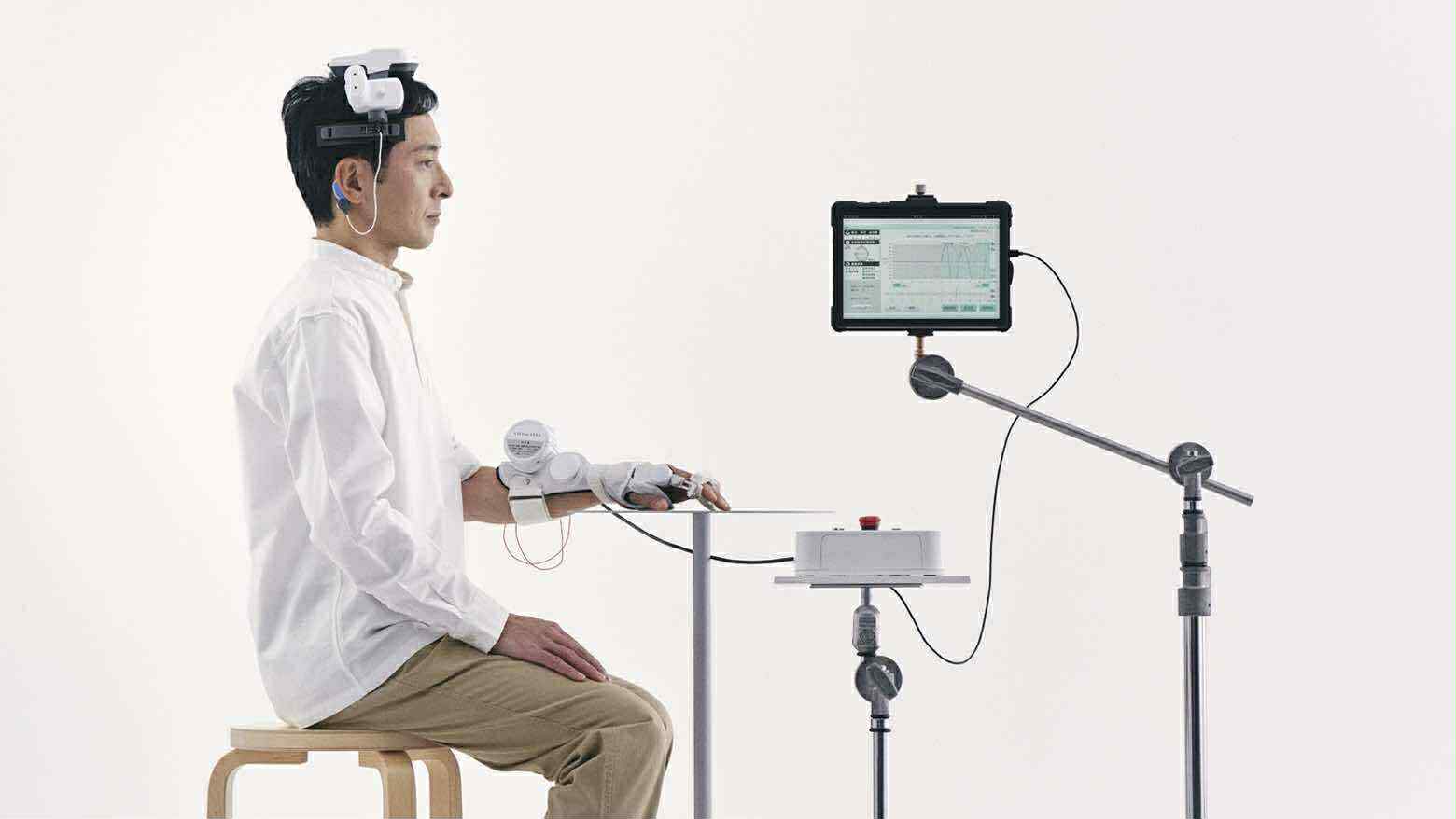
Broadly speaking, there are two types: one involves implanting electrodes directly into the brain, and the other – like our approach –uses wearable sensors placed on the head. Implantable types are extremely high in precision, but we have chosen the wearable approach as a technology that is more accessible and user-friendly.
Hashizume: So even with a wearable approach, achieving high precision is a key point, correct?
Ushiba: Recently, the capabilities of AI have advanced significantly and even with wearable systems, it has become possible to cleanly extract signals only from the specific regions of the brain that we want to observe.
Using this technology, we are able to read whether the appropriate motor-related signals are being generated in the brain when a patient attempts to move a paralyzed hand. We are developing BMI as a form of “brain rehabilitation” technology that helps patients relearn how to use their brain correctly.
Hashizume: So rather than simply reading brainwaves, the key distinction is that it is directly linked to treatment.
Ushiba: In particular, I believe our strength lies in having deep medical domain knowledge and using that to carefully determine where this technology should be positioned.
In practice, there are existing rehabilitation methods for patients with mild to moderate conditions, but for those with severe paralysis – who can’t even move their hands at all–there aren’t many sufficiently effective treatments. We believe that’s precisely where BMI can offer unique value.
We also have strong capabilities in AI development, which allows us to precisely extract internal brain signals at a clinical level of quality, even with a wearable system. This is a major technical advantage of our approach.
Hashizume: Thank you. Mr. Hayashi, could you also share how LIFESCAPES’ products differentiate themselves in the current competitive landscape?
Hayashi: The BMI field has been attracting significant attention in recent years, with more companies emerging both domestically and internationally under the context of neurotech and brain tech. In particular, investment in this area has been growing rapidly in the United States and China.
If I were to summarize what differentiates LIFESCAPES’ product in a single phrase, I would say it is the balance between therapeutic effectiveness and ease of use.
Therapeutic effectiveness refers to how much patients actually improve, whether that improvement translates into meaningful gains in daily life, and whether the time required to achieve those improvements is reasonable. On the other hand, ease of use is about whether the system can be seamlessly integrated into busy clinical settings. If setup takes 10 or 20 minutes, it becomes difficult to achieve widespread adoption in practice.
In general, when you prioritize therapeutic effectiveness, products tend to become more complex and closer to research-use systems. Conversely, when you prioritize ease of use, signal quality and clinical efficacy often suffer. We believe that through our accumulated R&D, we have been able to achieve a high level in both areas simultaneously and that is a major strength. In fact, this is something we are frequently recognized for by clinicians in the field.
Hashizume: Both from a technological and a business perspective, it seems you may be entering a phase where you establish the standard for the field. Speaking of your recent developments, being designated as a pioneering medical device was also a significant milestone. Could you tell us more about that as well?
Hayashi: For medical devices targeting the central nervous system, this designation is extremely rare. Ours is only the second case in Japan over the past ten years.
It’s not merely a certification; it is designed to speed up the development of innovative medical devices. We wanted both to demonstrate to society that our technology is truly innovative and to accelerate its development, so we spent over a year preparing through dialogue with regulatory authorities.
Having received the designation in December 2025, we plan to leverage this framework to further advance development. In fact, we are preparing to begin clinical trials within the next few months. As a company, we feel that we are now entering a phase of moving beyond research and development toward full-scale social implementation.
Research and Business: The Future LIFESCAPES Aims to Create
Hashizume: Before we conclude, I’d like to ask you to share a message. Professor Ushiba, may we start with you?
Ushiba: If fundamental research at universities can clearly demonstrate its effectiveness, then so-called translational research – bringing it to society through applied research and commercialization, including in the form of university-launched startups – will become increasingly important going forward.
Among the roles universities are expected to fulfill – education, research, and social contribution – this kind of social implementation is a concrete expression of that mission.
At the same time, I believe there are still those in academia who feel a sense of distance from business. However, commercialization is not simply about generating profit; it is also a way of testing whether a technology is truly needed by society. Receiving payment can be interpreted as evidence that we are providing value that people are willing to pay for.
Furthermore, when a technology spreads through society as a business, it opens up new possibilities for research. For example, as our technology has been used in clinical settings, large amounts of data have been accumulated, leading to new questions such as why it works for some patients but not for others. These insights are on a scale that cannot be obtained within academia alone, and they in turn lead to new scientific discoveries.
I believe that research and business are not in opposition; rather, they form a cycle and mutually enhance each other’s value. That is why I would especially encourage those in academia to turn their attention to these kinds of challenges.
Hashizume: Thank you. The perspective that new value can be created through the integration of research and business is highly insightful. Mr. Hayashi, I’d love to hear your thoughts as well.
Hayashi: We have already brought our product to market, and even as we speak, it is being used in clinical settings somewhere. In fact, the number of patients who are able to move their hands because of it is gradually increasing.
My mission, first and foremost, is to deliver this value to as many patients as possible. If we can increase the number of patients who benefit from this treatment, that alone represents the value of LIFESCAPES and will naturally translate into business success.
Furthermore, if LIFESCAPES can establish itself as a leading example of a university-originated medical startup, it could accelerate the commercialization of Japan’s outstanding research and help deliver greater value to society.
We also hope to inspire researchers and entrepreneurs –who are about to take on new challenges –by showing that this is another possible path. We intend to continue working toward making that a reality.
Hashizume: Thank you very much for sharing your valuable insights with us today.