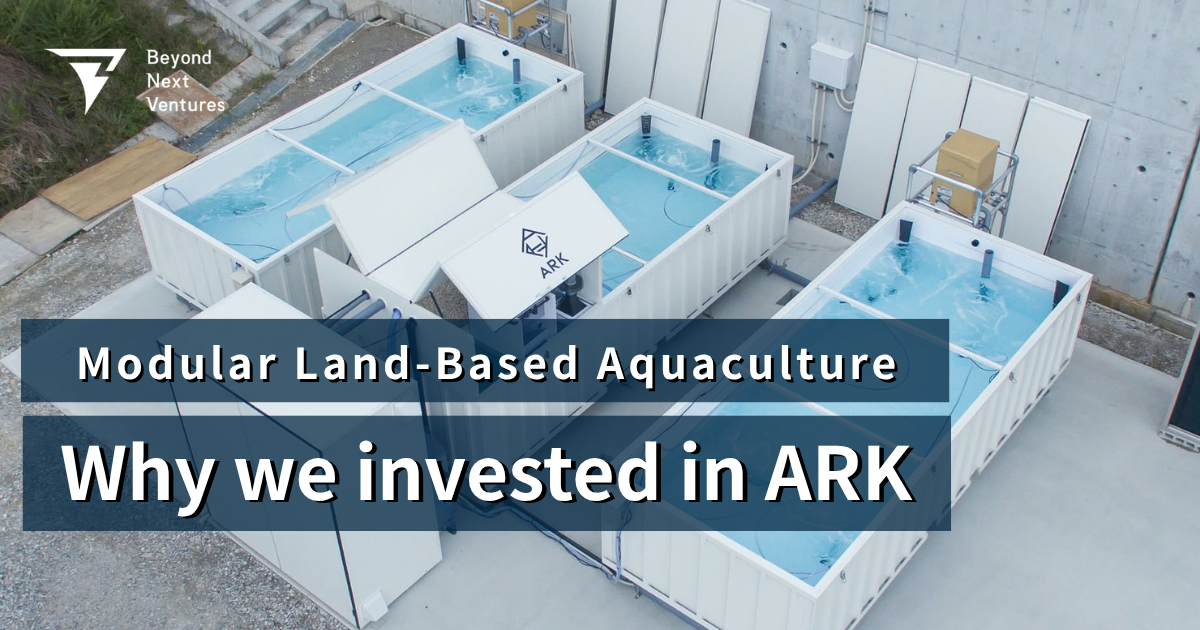


Raising fish on land.
Companies around the world have taken on this challenge. While land-based aquaculture holds enormous potential, building it into a commercially sustainable business has remained a challenge shared across the globe.
We recently made a new investment from our third fund in ARK Inc., whose mission is “LET THE OCEAN REST, CREATE YOUR OWN.”
Behind our investment is a major global shift. As populations grow and economies develop, global demand for protein continues to rise. At the same time, marine resources are finite, and global seafood production is undergoing a historic shift from “catching” to “farming.”
Large-scale land-based salmon farming plays an essential role in supplying protein to the world. Yet the global table extends far beyond salmon. Demand also exists for a wide variety of fish rooted in local food cultures. Japan, for example, has a long tradition of consuming species such as groupers and Japanese amberjack.
In working with this diversity of species, Japan has accumulated a broad base of technologies and expertise—from water treatment and purification to seed production, selective breeding and processing. This is one of Japan’s distinctive strengths. As food security becomes an increasingly important issue, the Japanese government has positioned land-based aquaculture as part of its growth strategy.
Looking toward 2030, the government’s roadmap calls for establishing land-based aquaculture in Japan for a diverse range of species in which the country has accumulated expertise, and then deploying those capabilities overseas in the form of modular systems.
By 2040, it has set a target of capturing 30% of the global market for seafood products and land-based aquaculture systems combined.
ARK is already moving along that path with both a product and real-world data. It has developed a modular system that can be deployed from a single unit and has spent more than five years raising fish itself and accumulating data.
The model allows operators to start small, without requiring large amounts of capital upfront, and expand step by step as they build operating experience.
Why is such a system needed now?
In this article, we explain why we decided to invest in ARK.
The Limits of the Ocean and a Historic Shift Toward Aquaculture
Aquaculture is already becoming a central pillar of the global seafood supply. In 2022, global aquaculture production of aquatic animals reached 94.4 million tonnes and, for the first time in history, surpassed capture fisheries production[1]. Much of aquaculture production, however, still relies on production in marine environments.
As it becomes increasingly difficult to expand supply by relying on the ocean alone, land-based aquaculture has emerged as another option. In particular, a land-based Recirculating Aquaculture System, or RAS, raises fish in tanks on land while filtering, purifying and recirculating the rearing water. This makes production possible away from the sea while reducing water use and environmental impact. This is the approach behind ARK’s systems.
At the same time, RAS still faces challenges related to cost structures and day-to-day operations. Across many applications globally, establishing stable and repeatable production at commercial scale remains a work in progress.
Aquaculture has long relied heavily on experience and intuition. Fish growth is affected by countless variables, including water temperature, water quality, stocking density, feed and how equipment is operated. What makes matters more difficult is the length of the validation cycle: after changing one condition, it can take months or even years for the fish to grow enough to determine the result. The complexity of these variables and the long validation cycle have made it difficult to formalise on-site knowledge into technology and transfer it in a reproducible form.
Land-based aquaculture also requires more than tanks. Filtration systems and equipment for controlling water temperature and water quality must be installed before production begins. This means substantial investment must be committed upfront, while returns can only be generated after the fish have had time to grow. The scale of the initial investment and the long period before capital can be recovered have both raised the barriers to entering land-based aquaculture.
From Small-Scale Trials to Full-Scale Expansion: ARK’s Design Philosophy
ARK’s ARK ZERO MATRIX is built around a modular architecture that can be expanded by adding units as operations grow. ARK itself describes this design concept as supporting applications “From Small-Scale Trials to Full-Scale Expansion.”
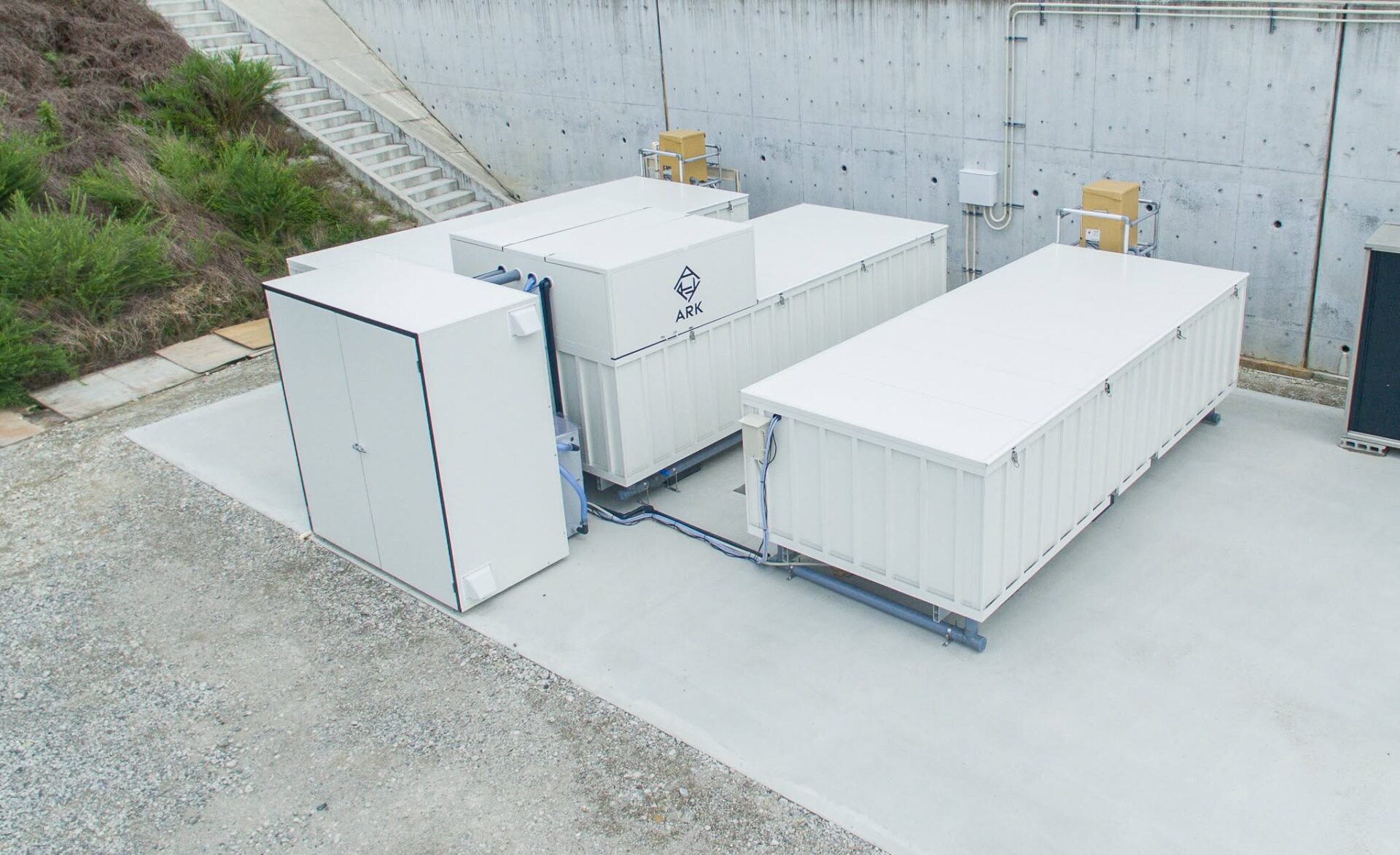
Deployment can begin with a single unit, with additional units added as production expands. This enables operators to enter land-based aquaculture with a more limited upfront investment and increase capacity progressively.
The benefits of a modular, smaller-scale design go beyond ease of entry. Because production is separated by unit, problems such as fish disease can be contained within a more limited part of the overall operation.
ARK has also designed its system with the economics of smaller-scale aquaculture in mind. Its highly airtight and thermally insulated tank structure, proprietary filtration system, and energy-efficient design help reduce operating costs, while the business targets high-value species such as groupers—including Malabar Grouper and Hybrid Grouper—as well as shrimp.
Groupers are also identified by Japan’s Fisheries Agency as a strategic aquaculture species, while the government’s Food Tech public-private investment roadmap identifies them among the principal species targeted by Japanese land-based aquaculture systems.
For fish such as groupers, optimal rearing conditions can vary depending on location, season and other environmental factors. Finding the right conditions therefore requires repeated trial and error. With production divided into smaller modular units, different conditions can be tested in parallel, allowing successful rearing methods to be accumulated as data.
And ARK has been building that data itself. For more than five years since its founding, the team has continued to raise fish through its own operations and apply what it learns to its products and operating methods. ARK’s current business model explicitly incorporates this feedback loop: by operating as a producer itself, it applies lessons from day-to-day aquaculture operations to the development of solutions and products.
Because each rearing cycle takes time, that accumulated trial and error becomes an important asset in its own right.
The Democratization of Aquaculture Is Already Underway
ARK’s business model is already beginning to be validated by the market. Its initial model sold out, and the current ARK ZERO MATRIX has entered the mass-production stage.
What stands out is the widening range of adopters. Users are no longer limited to fisheries businesses: ARK systems are being introduced by companies in industries such as construction and manufacturing, as well as by universities. ARK’s current website shows deployments across exactly these types of organisations. Companies and institutions that historically may not have considered aquaculture as a business are beginning to explore market entry using ARK’s systems.
For us, the significance lies less in the absolute number of installations than in the breadth of this adoption.
ARK’s vision of the “democratization of aquaculture” is not simply about selling equipment at a lower price. It is about delivering equipment together with operational know-how and data, creating a model in which even non-specialist operators can seriously consider aquaculture as a business. The fact that adoption is spreading into other industries suggests that this vision is already beginning to take shape. ARK itself describes its ambition as expanding participation by companies and individuals and promoting the democratization of aquaculture.
ARK’s Land-Based Seafood Production business currently supplies fish raised at its own facilities to supermarkets, specialist retailers, restaurants, and hotels, with inquiries emerging for ongoing commercial relationships.
Tangible demand for the systems themselves, combined with a positive market response to the fish they produce: seeing these two signals emerge together gives us confidence that ARK’s model is moving beyond concept and becoming a real business.
A Distinctive Position for Global Expansion
Many conventional land-based aquaculture models, particularly in Europe and North America, are large-scale, centralised and capital-intensive systems designed for high-volume production of species such as Atlantic salmon. ARK takes a different approach: Modular, Decentralised Systems focused on High-value Markets.
In our research, we found very few companies globally that have designed small-scale, modular systems specifically around high-value species and are also operating aquaculture businesses themselves. ARK is seeking to open up a new market in a segment that remains relatively undeveloped globally.
Groupers have strong demand as premium white-fleshed fish in Chinese-speaking markets and the Middle East. In the Middle East in particular, groupers—often known locally as “hamour”—are widely recognised and sought after as premium fish for high-end restaurants and hotels.
Warm climates also create a different set of economics. Salmon prefer colder water, which means that land-based salmon farming in high-temperature regions can require substantial cooling costs. This can make the economics of large-scale salmon RAS considerably more challenging. For ARK, which targets high-value species rather than large-scale salmon production and uses a modular approach, these markets present a meaningful opportunity.
This direction also aligns with the government’s roadmap. The roadmap envisages establishing land-based aquaculture systems domestically, modularising them for overseas deployment and ultimately capturing 30% of the global market by 2040. The market itself is projected to grow from JPY 0.35 trillion in 2025 to JPY 2.4 trillion in 2030 and JPY 31 trillion by 2040[2].
ARK has already signed an MOU with a UAE government-led public-private consortium to deploy its aquaculture systems in the UAE.
As food security becomes a growing policy priority, government support is strengthening both in Japan and overseas. The UAE project represents an important step in testing whether the technology and operational know-how ARK has developed in Japan can also work under different market and environmental conditions.
Three Co-Founders, Complementary Strengths
ARK was co-founded by Yosuke Kurihara, Isamu Yoshida and Koyo Takenoshita. At their previous company, all three worked on a water-quality sensing business for land-based aquaculture. There, they saw first-hand the barriers to commercialising land-based aquaculture, leading them to found ARK in 2020.
Yosuke Kurihara, Representative Director & Group CEO, leads management and global expansion. Working between London and Japan, he personally heads ARK’s discussions and business development in the UAE. His background includes capital and business partnerships as well as developing IoT and data-related ventures.
Isamu Yoshida, Director & COO, began his career in waterworks, repairs and building maintenance. He later taught himself programming and became a software engineer, before gaining broad experience across product development, sales and manufacturing. He has led ARK’s Okinawa operations and, while working directly with fish rearing, has helped expand its grouper aquaculture business to one of the largest of its kind in the prefecture. His background in waterworks and engineering, and his direct responsibility for aquaculture equipment and rearing, are also reflected in ARK’s current profile.
Koyo Takenoshita, Director & CTO, has a background in Robotics and Biomedical Engineering and sits at the core of ARK’s product and technology development. ARK’s profile notes his experience across product planning, development and production technology at hardware start-ups.
In land-based aquaculture, the companies that build the equipment and the operators who actually raise the fish can often be separated. ARK brings both together within a management team whose members have complementary strengths across management, technology and on-the-ground aquaculture operations.
That integration is what sustains the feedback loop described above: learning from the field and feeding that knowledge back into product development. It is also consistent with ARK’s own approach of operating as a producer and applying on-site learning to new solutions and products.
Toward Land-Based Aquaculture by Anyone, Anywhere
Of course, significant challenges remain. Securing seed stock and feed, achieving further energy efficiency and automating operations are just some of the issues that need to be solved as the business scales. ARK itself continues to work on next-generation systems and more advanced use of data.
Even so, we have our own answer to the question: Why now?
Aquaculture is becoming a central pillar of global seafood supply, while food-security concerns are creating policy tailwinds. At this historic turning point, ARK already has both real-world rearing data accumulated through its operations and a market-ready product.
ARK’s vision is “Creating a system and culture that enables land-based aquaculture by anyone, anywhere.”
That vision is not simply about selling equipment. It means providing a system through which companies and regions with no previous aquaculture experience can turn seafood production into a viable business.
A system that allows operators to start small, combined with reproducibility grounded in data. When these two elements come together, land-based aquaculture can move beyond being an industry accessible primarily to large-capital players and develop into one with a much broader base of participants.
We will continue to support ARK’s demonstrations and business development in Japan and overseas, working alongside the team toward the realisation of its mission: “LET THE OCEAN REST, CREATE YOUR OWN.”
-
List of Sources
- [1]Food and Agriculture Organization of the United Nations (FAO), The 2024 edition of The State of World Fisheries and Aquaculture (SOFIA)
- [2]Cabinet Office / Japan Growth Strategy Council, “Public-Private Investment Roadmap for Land-Based Aquaculture” (June 2026) / FISHERY JOURNAL